
Cold War and McCarthyism: The Political Climate of the 1950s
The 1950s were a time of hope and fear in American society. After the end of World War II, America became one of the world’s strongest countries. But a new conflict started almost immediately thereafter. This battle was known as the Cold War. It was a long period of tension between the United States and the Soviet Union (Russia).
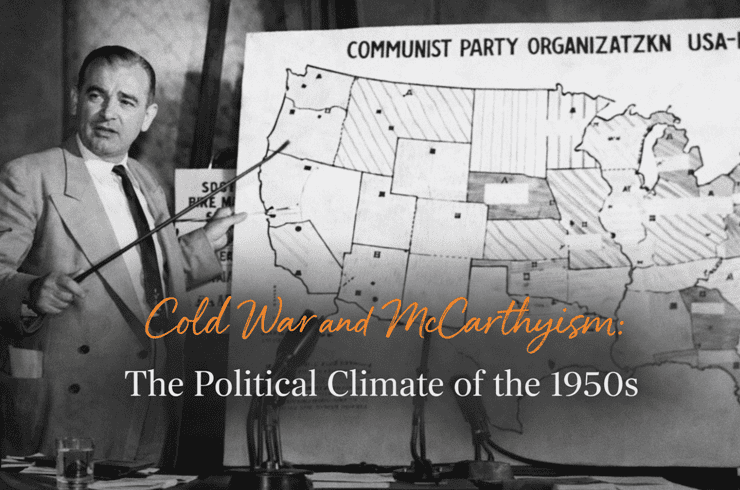
Cold War and McCarthyism: The Political Climate of the 1950s
At the same time, communism became more feared within the country. This fear resulted in a movement called McCarthyism. Together, the Cold War and McCarthyism influenced the political situation of the 1950s in powerful ways.
What Was the Cold War?
The Cold War was not a traditional war in which armies fought battles. The other was a political and military rivalry between two superpowers.
The United States was democratic and capitalist. The Soviet Union was a supporter of communism, in which the government controls most property and business.
Two countries sought to spread their influence worldwide. They competed in such things as:
- Military strength
- Nuclear weapons
- Space exploration
- Political alliances
Though they never went to war directly, the frequent conflict affected world politics for decades.
Fear of Communism in America
At the end of the 1940s and into the 1950s, many Americans were afraid that communism might spill over into the United States. Events around the world have caused this worry to grow.
For example:
- The first atomic bomb was tested by the Soviet Union
- China became a communist nation in 1949
- The Korean War began in 1950
These events led Americans to feel that communism was getting stronger.
People were concerned that communist spies could be residing in the United States. This fear resulted in investigations and accusations.
Who Was Joseph McCarthy?
Joseph McCarthy was a U.S. senator from Wisconsin. In 1950, he asserted the existence of communists in the U.S. government.
McCarthy stated that he had a list of government employees who were secretly communists. Although he did not present impressive proof, his claims were noticed.
McCarthy started to lead investigations to find and expose communists who might be in hiding. His actions came to be known as McCarthyism.
What Was McCarthyism?
McCarthyism was the act of accusing without solid cause of communism. Many people were questioned about their political beliefs.
Government workers, teachers, writers, and actors were investigated. Some lost their jobs just because they were suspected of being communist.
In Hollywood, actors and filmmakers were put on “blacklists.” This meant that they could not find work if they refused to answer questions about their beliefs.
Fear was incorporated into everyday life. People were concerned that neighbors or coworkers would report them.
Loyalty Oaths and Inquisitions
During this period, the government required many workers to sign loyalty oaths. These oaths included the following: They were not members of the Communist Party.
A group known as the House Un-American Activities Committee (HUAC) also investigated suspected communists. Public hearings were held, and people were asked to mention others who may have communist connections.
Refusal to answer questions could lead to a jail sentence or loss of employment.
Impact on Daily Life
The Cold War and McCarthyism had an impact on everyday life in the 1950s.
Schools participated in “duck and cover” drills in the event of a nuclear attack. Families made bomb shelters in their backyards. The news reported frequently on nuclear weaponry and world tension.
Fear of communism influenced politics, media, and education. Many Americans became afraid to openly profess political ideas.
The Fall of McCarthy
By the middle of the 1950s, McCarthy was in decline. In 1954, televised hearings introduced the public to his aggressive questioning style.
Many Americans believed that his allegations were unfair and damaging. Later that year, the Senate officially criticized McCarthy’s actions. His influence quickly diminished.
Although McCarthyism ended, the Cold War continued for many years.
Long-Term Effects
The political situation of the 50s left a strong impression on American society. The fear of communism led to foreign policy and military spending. The United States invested a huge amount of money in defense and nuclear weapons.
McCarthyism also sparked questions about civil rights and freedom of speech. Many innocent people died by accusations without proof.
Over time, Americans came to value better protections for individual rights.
The Cold War and McCarthyism were the defining features of political life in the 1950s. Global tension with the Soviet Union led to fear at home. Leaders such as Joseph McCarthy used that fear to come into power, which led to investigations and public accusations.
This era reminds us of the power of fear to influence politics and public opinion. It also shows the importance of safeguarding democratic values, even in times of uncertainty.