
1950s School Life: What Classrooms and Student Culture Were Really Like
School life in the 1950s reflected the values and routines of mid-century America. Schools were concerned with discipline, respect for the teacher, and good study habits. Classrooms were arranged and tidy, and students had definite rules and daily schedules.
For children growing up in this decade, school was more than a place to learn to read, write, and do arithmetic. It was also where friendships formed, social expectations were developed, and young people began to understand their place in society.
The classroom experience in the 1950s was quite different from what schools are like today. Technology was scarce, teachers were in firm control, and many lessons were textbook- and memorized. At the same time, school events, sports, and extra-curricular activities played an important role in the culture of students.
Classroom Organization and Daily Routine
A characteristic day of school life in the 1950s was a predictable schedule. Students came in on time in the morning and started the day with attendance and announcements. In many schools, too, the day also began with the Pledge of Allegiance, a mark of the intense patriotic mood of the era.
Classrooms were laid out in neat rows of wooden desks facing the teacher’s desk and chalkboard. Teachers conducted instruction from the front of the room, and the students were expected to listen carefully, participating when called on.
Common subjects were reading, spelling, math, history, science, and handwriting. Penmanship was considered important, and practice was often done using fountain pens and ink. Unmessy and neat handwriting was considered an important skill.
Homework was common, and teachers expected assignments to be done carefully. Grades and behavior were taken seriously, and discipline was a day-to-day rather than an occasional occurrence in the lives of the school.
The Role of Teachers
Teachers were very respected in the 1950s. Students were expected to be polite, follow directions, and be respectful in all situations. It was a standard address of teachers as “Mr.” or “Mrs.” followed by their last name.
Discipline presented was stricter than it is nowadays in most schools. Students who were misbehaving may have to stay after school or do additional assignments. In some schools, harsher punishment was also employed, which reflected the conventions of educating at the time.
Even with the strict rules, many of the teachers developed strong relationships with their students. They often served as role models who encouraged responsibility, good behavior, and hard work.
School Supplies & Learning Material
Technology was very limited in the 1950s classrooms. Most learning was done by means of textbooks, notebooks, pencils, and chalkboards. Teachers used the large blackboards to explain the lesson and write the examples for students to copy.
Basic school supplies were quite simple, but important: Many students carried lunch boxes made of metal and were decorated with colorful designs and popular characters. Pencil cases typically came with erasers, rulers, and sharpeners.
School libraries were also an important aspect of learning. Students regularly visited the library to borrow books to use for assignments or for personal reading.
Being in a world where digital tools did not exist meant students relied heavily upon reading, writing, and listening during a lesson.
School Dress and Appearance
Clothing and appearance were serious in school life in the 1950s. The students were expected to be neat and well-groomed.
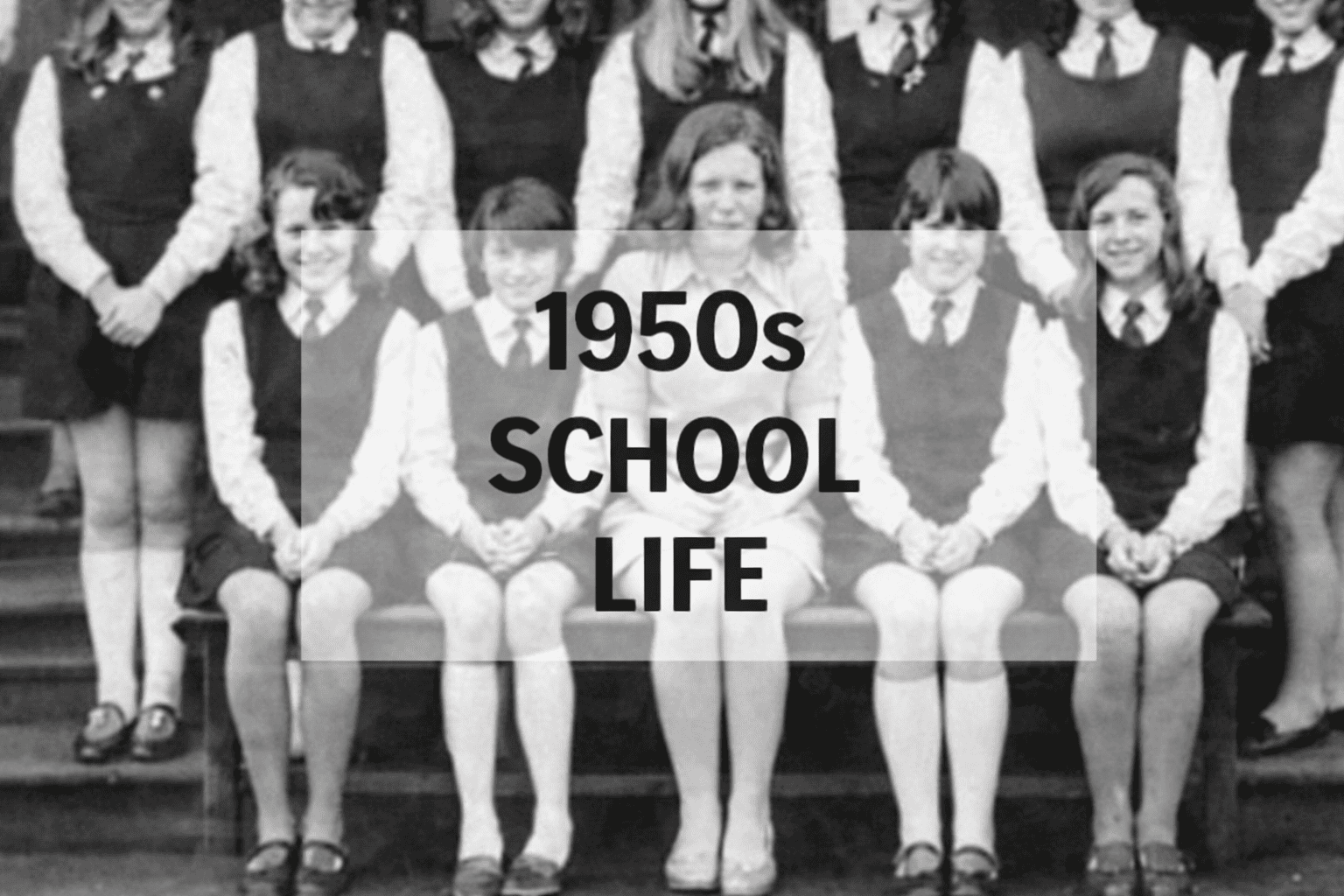
Boys normally wore button-down shirts, sweaters, and simple trousers. Jackets or ties were sometimes worn for a special occasion. Girls would often wear dresses/skirts with blouses and cardigans/sweaters.
Hair was usually neat and conservative. Schools required students to conduct themselves in a respectful manner while in class.
Even though uniforms were not a requirement throughout the school, there were dress guidelines in many schools that helped to keep the classroom environment formal.
Extracurricular Activities/School Events
School life in the 1950s was not all about learning in the classroom. Many students also took part in ‘out of hours’ activities.
Sports were especially significant, particularly in high schools. Popular sports were football, basketball, and baseball. School teams frequently united communities over the course of games and competitions.
Music programs, drama clubs, and student councils were likewise typical. These activities enabled the students to develop their interests and make friendships.
School dances were very popular among the teenagers. Events such as sock hops and school socials offered students an opportunity to listen to music, dance, and spend time with other students.
These activities contributed to a great sense of school community.
Friendships and Social Life
Friendships were an important aspect of 1950s school life. But students spent a lot of their day together in the classrooms, on the playgrounds, and at school events.
Recess provided class time for children to unwind and play with their peers in between lessons. Popular games on the playground were jump rope, hopscotch, marbles, and basic ball games.
Older students would frequently stay after school for clubs, sports practice, or school events. For many young people, school was the primary source of hanging out and forming lasting friendships.
For many students, these friendships became one of their best school memories.
How Education Reflected the Values of the Time
Education in the 1950s was a symbol of the social values at the time. Schools were focusing on discipline, respect, and responsibility. Teachers exhorted students to work hard, abide by rules, and prepare for adulthood.
The Cold War had also affected education. Subjects such as science and mathematics received greater attention as the United States turned its focus to technological advancement and competition abroad.
Schools sought to prepare students not only for life academically but for life socially – to show the students how to be responsible members of their communities.
The Lasting Influence of 1950s School Life
Although the classroom has changed dramatically since the 1950s, many elements of education at the time still have an impact on schools today. Organized schedules, orderly classrooms, and extracurricular activities are not unusual parts of the school experience.
At the same time, nowadays modern classrooms are also characterized by introducing advanced technology, new methods, and more flexible learning spaces.
Looking back at life at school in the 1950s gives us a snapshot of what it was like at a time when discipline, routine, and community played such big parts in the lives of students. These schools helped to educate a generation that would help define many of the social and cultural changes to come in the decades to come.