
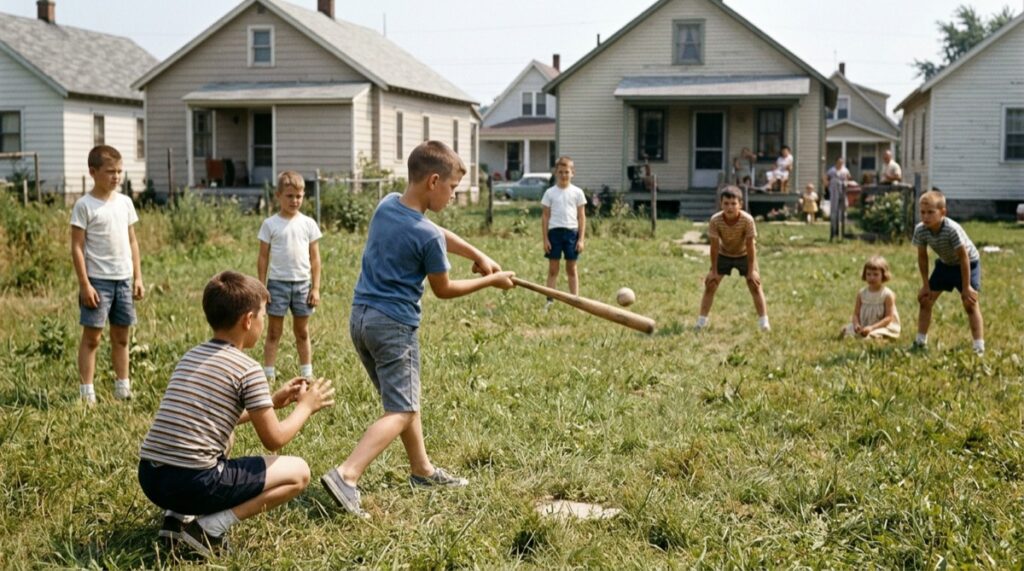
School let out, the screen door banged behind you, and by ten in the morning half the street was already standing in the empty lot with one bat and a ball that had seen better days. If you grew up in the 1960s, you probably remember summers measured in innings, not hours.
That kind of baseball didn’t need a league office or a groomed diamond. It needed kids, a patch of grass and somebody’s mom calling everyone home when the streetlights came on. Most of it still works today, for a reunion game with old friends or for grandkids who’ve never played on a vacant lot.
Here’s how to bring 1960s neighborhood baseball back to your block, step by step.
Step 1 – Start With the Kids on Your Block
Neighborhood baseball starts with whoever lives close enough to walk over. In the 1960s, nobody signed up. You knocked on doors, yelled across backyards and played with whoever showed up. The eight-year-old who could barely hold the bat played alongside the teenager who threw too hard.
Ball fields were a bonus, not a requirement. The Encyclopedia of Cleveland History notes that for most people, baseball meant pick-up games played in vacant neighborhood lots . The same was true on plenty of other blocks. A side yard, a dead-end street or a corner of the local park will do.
Before the first game, round up the basics:
- A wooden bat that the smaller kids can swing
- Two or three balls, since one will end up in a hedge
- A few gloves to share between innings
- Four flat objects for bases, like old cushions or feed sacks
Don’t wait until you have eighteen players. Six kids can play a perfectly good game and more will come once they hear the bat.
Step 2 – Set Ground Rules That Fit Your Field
Ground rules are what made neighborhood baseball work on any patch of grass. Every lot had its own, and kids would argue over them longer than they played some innings. Decide yours early so the game keeps moving.
Shrink the Field to Your Space
Pace out the bases to suit the youngest players and the size of the lot. If the street sits beyond left field, call anything hit into the street an out. A realistic field beats a regulation one.
Borrow the Classic 1960s Rules
Many neighborhoods used the same handful of fixes:
- Right field closed when there aren’t enough players
- Pitcher’s hand counts as first base for a quick out
- Ghost runners stay on base when a batter has to take a turn in the field
- Do-overs for any ball that hits a parked car or a tree
Pick Sides the Old-Fashioned Way
Two captains, one bat, hands climbing up the handle until someone’s fingers reach the knob. Whoever gets the last full grip picks first. It’s fair, it’s fast and it saves you from making the call yourself.
The one rule that matters most: agree on the ground rules before the first pitch. A missed rule causes more arguments than a missed catch.
Step 3 – Name the Team After Your Street
Team names gave 1960s neighborhood baseball its sense of belonging. Kids named themselves after their street, their school, the creek behind the houses or the local business that paid for the shirts. Little League teams often carried a sponsor’s name across the back, so a team might be the Elm Street Hawks one summer and the Hardware Store Pirates the next.
When you name the team after your street or a local landmark, every neighbor knows who you are before the first inning. It also gives the kids something to shout from the bench.
Keep the name short enough to fit on a shirt and easy enough for a six-year-old to cheer. If two streets want to play each other, let each pick its own name, and suddenly you have a rivalry worth a whole summer.
Top Tip: Before you settle on a team name, say it out loud as a cheer from the bench three times. If it trips anyone’s tongue or takes too long to shout, shorten it. The names that lasted on 1960s blocks were the ones kids could yell from the outfield without thinking.
Step 4 – Choose Team Colors and Matching Uniforms
Matching colors turned a pickup crew into a real team in the 1960s. A sponsored Little League squad might wear wool flannels with the business name stitched across the chest, while a block team might settle for the same color T-shirt from the five-and-dime. Either way, wearing the same colors told everyone in the park who belonged together.
Pick two colors, one main and one trim, and stick with them for everything you add later. Navy and red, green and gold, or black and orange all read well from across a field and look right in old-style photos.
If you want the look of a 1960s sponsored team, plan the full design before you order, including the team name lettering and the numbers on the back. You can compare your sketch against listings for custom baseball uniforms from Sports Gear Swag, where team colors, player names and numbers are part of the design. Collect every player’s size before you order, since kids grow fast between one summer and the next.
For a period feel, a button-front jersey with the team name in an arched script across the chest is a safe choice. Add numbers on the back so younger players can find their own shirt in a pile and keep the lettering simple so it still reads from the bleachers.
Step 5 – Keep the Summer Rhythm Going
The 1960s baseball summer had a rhythm: games in the morning before it got hot, a break for lunch, and another game after supper that lasted until nobody could see the ball. You can build the same routine today by setting a regular time that everyone on the block knows.
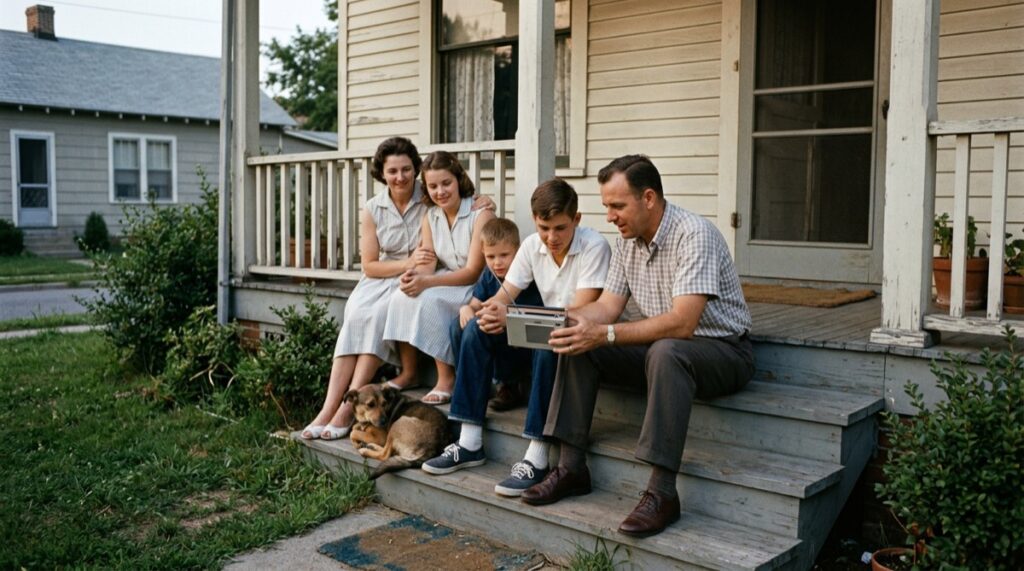
Evening games are still the best. The heat drops, parents come out to sit on the porch steps, and someone can bring out a transistor-style radio so the big-league game plays in the background, the way it did on so many streets.
Hot afternoons need a plan. The CDC advises athletes to drink more water than usual and not to wait until they’re thirsty. Keep a cooler of water by the bench and call a break every few innings. Pitchers and catchers work hardest, so rotate them.
Keep the season loose. Not every kid will show up every day, and that’s part of the charm. Let the game be the thing everyone wanders toward, not another appointment.
Step 6 – Record the Season Like a 1960s Family
Families in the 1960s kept their baseball summers in photo albums and dog-eared scorebooks. Those records are the reason so many people can still name their childhood teammates decades later. Start keeping yours on day one.
Save a few things from every season:
- A team photo with everyone in their colors
- The scorebook, even if half the innings are missing
- A roster with each player’s name and number
- One shirt or cap from the final game
To keep a scorebook the old way, assign one of the parents or an older kid to the job and use a simple paper book with box scores. Kids love seeing their hits written down, and the handwriting alone will be worth something in twenty years.
Pick a Date for Your First Block Game
You don’t need a full roster or a perfect field to bring 1960s neighborhood baseball back. You need a date, a place and a few kids willing to give it a try. Walk the block this week, ask who wants to play, and set the first game for the next Saturday morning. If it rains, play the next one.
Frequently Asked Questions
How many players do you need for neighborhood baseball?
Six players can play a full neighborhood game. Close right field and use ghost runners when you’re short, the way 1960s kids did.
What colors look most like 1960s team uniforms?
Two-color pairings like navy and red, green and gold, or black and orange read well from across a field. They also look right in old-style team photos.
What did kids use for bases in the 1960s?
Kids used whatever was flat and close at hand. Old cushions and feed sacks both worked as bases on neighborhood lots.