
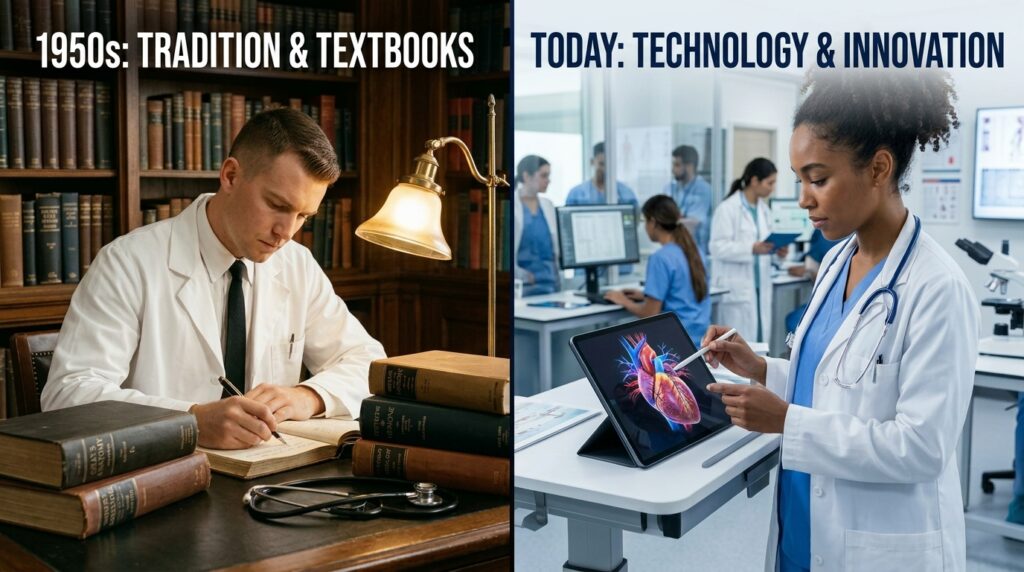
Becoming a doctor has never been an easy road. It takes years of studying, hands-on training, and learning how to make important decisions when someone’s health is at stake. But what that journey looks like has changed quite a bit since the 1950s. Back then, future doctors worked through demanding classes, long hospital shifts, and a medical field that was still making some of its biggest discoveries. Today, students have advanced technology, better learning resources, and more structured training. But they also deal with rising tuition, tough competition, and growing professional expectations.
So, was becoming a doctor harder in the 1950s, or is it harder today? The answer isn’t as simple as it might seem. Both generations faced serious challenges. They were just different kinds of challenges.
Getting Into Medical School Then and Now
In the 1950s, becoming a doctor usually meant completing undergraduate studies before attending four years of medical school. Getting accepted wasn’t easy, but the admissions process looked different from what students experience today. Good grades mattered, of course. But personal recommendations, interviews, and connections could also play an important role.
There were also barriers that had little to do with academic ability. Many medical schools restricted opportunities for women and racial minorities, making it difficult for qualified students to enter the profession. By the late 1950s, women made up only around 6 percent of medical students in the United States. Today, medical school admissions are more standardized, and opportunities are open to a much broader group of applicants.
Students need strong academic records, competitive MCAT scores, clinical experience, and recommendations. Research projects, volunteer work, and leadership experience can also help. And for many applicants, the preparation starts years before they actually apply. The process may be more transparent than it was decades ago, but that doesn’t mean it’s easier. With so many qualified students competing for limited places, getting accepted remains a major achievement.
How Medical Education Has Changed
Imagine studying medicine without online journals, digital anatomy tools, or instant access to research. That was everyday life for medical students in the 1950s. Most learning happened through textbooks, classroom lectures, laboratory work, and time spent observing doctors in hospitals. Students studied anatomy, physiology, pathology, and pharmacology, just as they do today. But finding information often meant searching through books or asking experienced physicians.
There weren’t digital simulations to help students practice complicated clinical situations before meeting real patients. Today, the classroom experience is almost unrecognizable. Medical students can use three-dimensional anatomy models, digital learning platforms, clinical simulations, and advanced imaging technology. They can also access medical research from around the world in seconds.
These resources make learning more interactive and give students opportunities that earlier generations never had. But there’s another side to it. With so much medical information available, today’s students must learn more and keep up with an expanding body of research. Technology can make studying more convenient, but it doesn’t remove the pressure of understanding complex information. And when students begin working with patients, they still need the same basic qualities doctors have always needed. Good judgment, careful observation, and the ability to listen.
Residency Training Was Tough in Both Eras
Medical school graduation isn’t the finish line. It’s the beginning of another demanding stage. In the 1950s, new doctors commonly completed an internship before starting independent practice or continuing into specialty training.
Hospital work could be exhausting.
Interns and residents often worked extremely long shifts, sometimes staying at the hospital overnight with very little rest. There were few formal limits on working hours, and the culture of medical training placed a strong emphasis on endurance. Today, residency programs follow clearer standards. Depending on their specialty, doctors typically spend three to seven years in residency. Training includes supervised patient care, clinical assessments, and ongoing education.
Modern rules generally limit resident working hours to 80 per week, averaged over four weeks. Still, 80 hours is a lot of time to spend at work. Residents continue to handle overnight shifts, demanding patient cases, and the pressure of making important clinical decisions. The difference is that today’s programs place greater emphasis on supervision, patient safety, and physician well-being.
Even with these improvements, burnout and fatigue haven’t disappeared. They remain real challenges for doctors in training.
The Financial Side of Becoming a Doctor
One of the biggest changes between the 1950s and today is how much medical education costs. During the 1954 to 1955 academic year, average annual tuition for resident medical students was approximately $645. That wasn’t a small expense for families at the time. But compared with today’s medical school costs, the difference is striking, even after adjusting for inflation.
Modern medical students often spend tens of thousands of dollars each year on tuition alone. Then there’s housing, transportation, textbooks, food, and all the everyday costs that come with being a student. According to the Association of American Medical Colleges, the median educational debt among indebted medical school graduates in 2025 was approximately $215,000.
That’s a significant financial burden to carry into a career. And it doesn’t necessarily become easier right after graduation. Residents spend several years earning much less than fully trained physicians while managing their loans and everyday expenses. It’s one reason financial planning has become an important part of the modern medical journey. Some physicians eventually choose to explore options to refinance medical student loans in hopes of securing a lower interest rate or adjusting their repayment terms.
Of course, refinancing isn’t the right choice for everyone. Moving federal student loans to a private lender means losing access to federal repayment benefits, including certain income-driven plans and loan forgiveness programs. It’s worth considering those tradeoffs carefully.
For today’s medical students, the challenge isn’t only getting through school. It’s also finding a way to build a stable financial future afterward.
Doctors Have More Medical Knowledge to Master
Medicine was advancing quickly in the 1950s. Antibiotics were changing how doctors treated infections. Vaccines were helping prevent serious diseases. Surgical techniques were also becoming more sophisticated. But doctors still worked with far fewer diagnostic and treatment tools than physicians have today.
There were no routine MRI scans, modern genetic tests, or many of the minimally invasive procedures we now take for granted. Doctors relied heavily on physical examinations, patient histories, and their own clinical experience.
Those skills are still essential.
But modern physicians have access to tools that can reveal problems earlier, support more accurate diagnoses, and make treatments more precise. Today’s medicine includes advanced imaging, targeted cancer therapies, robotic-assisted procedures, and genetic research. It’s remarkable how far the field has come. But every new development creates something else doctors need to learn. Medical guidelines change. New treatments appear. Technologies that were once considered groundbreaking eventually become standard practice. That means today’s doctors must keep learning throughout their careers.
Graduating from medical school is only one step in that process.
The Doctor and Patient Relationship Has Changed
In the 1950s, doctors generally held more authority over medical decisions. Patients often trusted their physicians to decide what treatment was best, sometimes without much discussion about other options.
Today’s approach is different.
Modern healthcare places more emphasis on informed consent, patient preferences, and shared decision-making. Doctors are expected to explain treatment choices, discuss potential risks, and help patients understand their options. That takes communication skills, patience, and empathy. And those qualities matter just as much as medical knowledge.
At the same time, doctors now deal with responsibilities that weren’t as prominent decades ago. Electronic health records, insurance paperwork, regulatory requirements, and administrative duties can take up a significant part of the workday. These systems can support safer and more coordinated care, but they also add complexity to an already demanding profession.
Being a doctor today means doing more than diagnosing illnesses and prescribing treatments. It means helping patients navigate a healthcare system that can sometimes feel overwhelming.
What Hasn’t Changed About Becoming a Doctor
For all the differences between the 1950s and today, some things about medicine remain surprisingly familiar. Students in both generations have spent long nights studying for difficult exams. They’ve walked into hospitals feeling nervous about what they might encounter.
They’ve had moments when they questioned whether they were ready for the responsibility ahead. And they’ve had to learn how to stay focused when patients needed them most. The medical tools have changed, but the human experience hasn’t changed nearly as much. A patient sitting in an examination room still wants someone who will listen, take their concerns seriously, and offer thoughtful care.
That doesn’t depend on the decade.
It depends on the person wearing the white coat.
Final Thoughts
Comparing what it took to become a doctor in the 1950s with what it takes today shows just how much medicine has changed. Earlier generations trained with fewer technological resources, less structured working conditions, and barriers that prevented many qualified people from entering the field. Today’s doctors benefit from better educational tools, advanced science, and clearer training standards.
But they also face rising education costs, significant debt, and a healthcare system that demands more from them in different ways. So, which generation had it harder? There probably isn’t one answer that fits everyone. What we can say is that becoming a doctor has always required dedication, sacrifice, and a willingness to keep learning.
The challenges may look different today, but the commitment behind the profession is much the same.