
In October 1957, the world changed in an instant. The Soviet Union launched a small metal satellite, Sputnik, into space. It became the first man-made object to orbit the planet Earth. This single event shocked the United States, and the Space Race began.
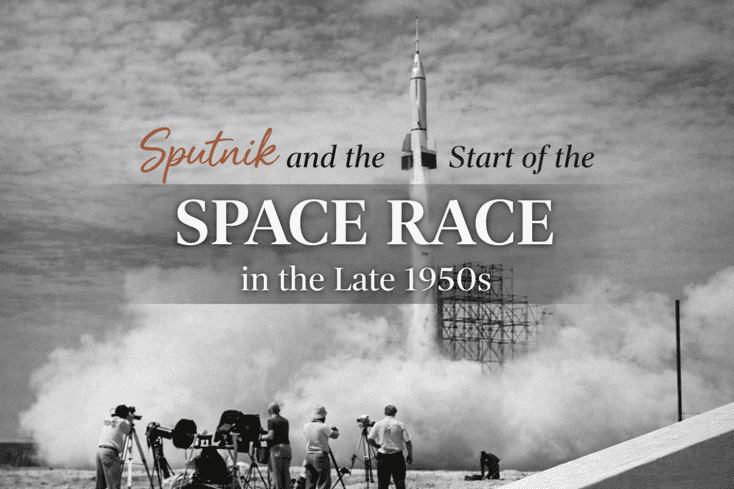
Sputnik and the Start of the Space Race in the Late 1950s
Sputnik was not large. It was on the order of a beach ball. But its impact was huge. It proved that the Soviet Union had advanced rocket technology. This brought fear and urgency to America during the Cold War.
What Was Sputnik?
On October 4, 1957, Sputnik 1 was launched. It encircled Earth once every 96 minutes and relayed basic radio transmissions returning to Earth. People around the world could hear its steady “beep” through radio equipment.
The satellite was not equipped with weapons itself. But the rocket used to deliver it proved that the Soviet Union was capable of sending objects far into space. Americans realized that the same kind of rocket could possibly be used to carry nuclear weapons.
This realization heightened Cold War tension.
Why America Was Shocked
Before Sputnik, many Americans thought that the United States was at the forefront of science and technology. The launch made it look as though the Soviet Union was a step ahead.
Newspapers dubbed it the “Sputnik crisis.” Parents, teachers, and politicians were concerned about the fact that American schools were not preparing students well enough in the areas of math and science.
Fear spread quickly:
- Could Soviet rockets hit American cities?
- Was the U.S. languishing in technological backwardness?
- Would communism be more influential worldwide?
Sputnik became more than a satellite. It became the symbol of competition.
The Birth of the Space Race
After Sputnik, the United States scrambled to respond. The rivalry between the two superpowers to explore space came to be known as the Space Race.
The goal was clear:
- Build better rockets
- Launch satellites
- Send humans into space
- Display technical superiority
In 1958, the US launched the first satellite called Explorer 1. The same year, the government established the National Aeronautics and Space Administration, or simply called it the shorthand for the words: “NASA”.
NASA became accountable for America’s space program.
Changes in Education
Sputnik did more than have a political impact. It changed American education.
The National Defense Education Act was passed by the government in 1958. This law boosted funding to science, math, and foreign language programs in schools.
Schools began focusing more on:
- Science labs
- Math skills
- Engineering programs
Colleges grew research in the fields of physics and space science. The United States wanted to ensure that it would not fall behind again.
Technology and Innovation
The Space Race brought great advances in technology with it. Scientists worked harder and faster to build better rockets, better computers and better communications.
This period led to:
- Developments in satellite communication
- Improved weather prediction
- Increase in computer technologies
Many things that we take for granted today developed from the research that was being done during the Space Race.
Sputnik 2 And Persisting Competition
A month after Sputnik 1, Sputnik 2 was sent out by the Soviet Union. This satellite carries a dog named Laika, the first animal to orbit Earth.
This second launch put pressure on the US. The race was well and truly on.
Over the next decade, both nations entered into fierce competition. The first human, Yuri Gagarin, was sent by the Soviet Union in 1961. The United States later responded with the Apollo program, which landed astronauts on the moon in 1969.
Impact on American Identity
Sputnik helped to alter the identity of the American people. It turned the assumption that the United States was always first in innovation.
The event also created national unity. Citizens were for science funding and space exploration. Space became a symbol of progress and a potentiality.
Children grew up dreaming of being an astronaut. Space-themed toys, television shows, and school projects became the rage.
Sputnik and the beginning of the Space Race in the late 1950s were a turning point in History. A little satellite started the whole world competition, scientific development, and education changed.
What started as a Cold War rivalry drove both countries to explore beyond the Earth. Sputnik’s steady beep signaled to the world the dawn of a new age of space exploration that is being conducted to this day.