
The Beginnings of the Civil Rights Movement in the 1950s
It was a time of change in the United States in the 1950s. While many Americans were happy, the economy was growing, and suburban areas were being created, African Americans still had to deal with segregation and discrimination. Separate schools, restaurants, buses, and neighborhoods were common, particularly in the South. These unjust laws were called Jim Crow laws.
The Beginnings of the Civil Rights Movement in the 1950s
The origins of the Civil Rights Movement in the 1950s. The 1950s saw the beginning of organized efforts to oppose racial inequality. Brave people and groups worked together demanding equality under the law.
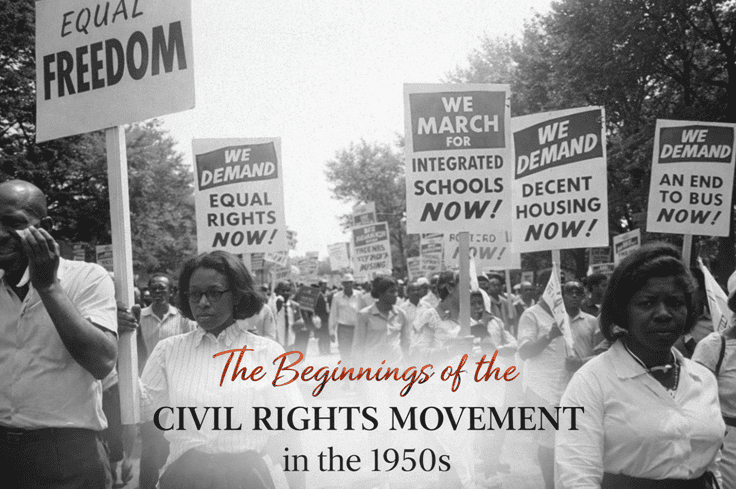
Segregation and the Jim Crow Laws
After the Civil War finally ended in 1865, African Americans were legally free. However, many states in the South developed laws that would separate black and white citizens. These laws governed where the people could live, what they could eat, where they could learn, and where they could go.
Public facilities were marked “White Only” or “Colored.” Black schools often received less funding and fewer resources. Unfair tests and fees also restricted voting rights.
By the early 1950s, many African Americans were fed up with these injustices and were willing to demand change.
Brown v. Board of Education (1954)
One of the biggest milestones in the early years occurred in 1954. In Brown v. Board of Education, the United States Supreme Court ruled that segregated public schools were unconstitutional.
This decision overruled an earlier 1896 decision that had permitted “separate but equal” facilities. The Court ruled that separate schools were not really equal.
The ruling did not immediately end segregation, but it gave the Civil Rights Movement legal support and hope.
The Role of the NAACP
The National Association for the Advancement of Colored People (NAACP) was heavily involved in the early civil rights struggle. Founded in 1909, the NAACP relied on legal action in the fight for freedom from discrimination.
Lawyers like Thurgood Marshall fought cases in court to challenge segregation laws. Their efforts helped to bring about the Brown v. Board of Education decision.
The NAACP demonstrated that the law could be used to combat injustice.
The Montgomery Bus Boycott (1955-1956)
The Montgomery Bus Boycott was one of the other important events that took place at the beginning of the Civil Rights Movement.
In December of 1955, Rosa Parks refused to give up her seat on the bus to a white passenger in Montgomery, Alabama. She was brought up on trial for violating segregation laws.
In response, African American residents boycotted the city’s buses. For over a year, they refused to ride them. Instead, they walked, carpooled, or found some other way to get around.
The boycott lasted 381 days and brought on major financial problems for the bus system. In 1956, the Supreme Court declared that bus segregation was unconstitutional.
The Rise of Martin Luther King Jr.
During the Montgomery Bus Boycott, a young minister named Martin Luther King Jr. rose to become a national leader. He advocated a nonviolent protest movement guided by the teachings of Mahatma Gandhi.
King had the belief that through peaceful resistance, change could be brought. His leadership brought the movement direction and strength.
He later helped form the Southern Christian Leadership Conference (SCLC), which held nonviolent protests throughout the South.
Sit-Ins and Student Activism
Toward the end of the 1950s, students began to play a major role in civil rights efforts. In 1960, four college students in North Carolina’s town of Greensboro sat at a separate table in a lounge and refused to leave.
Although this event occurred just after the 1950s, it was inspired by earlier activism. Sit-ins became an effective tool of protest. Young people demanded service at places that did not treat them equally.
Student activism was a testament to how the movement was growing stronger.
Challenges and Resistance
The beginnings of the Civil Rights Movement were strongly resisted. Some state leaders refused to obey orders from federal courts. In 1957, nine Black students tried to attend Central High School in Little Rock, Arkansas.
The governor tried to prevent them from going inside. President Dwight D. Eisenhower sent in federal troops to protect the students and force integration.
This event demonstrated that change would not come easily, but it also demonstrated that the federal government was able to agree with the civil rights movement.
Lasting Impact
The 1950s set the stage for massive civil rights victories in the 1960s. Early court cases, boycotts, and peaceful protests built momentum.
These beginnings led to:
- The Civil Rights Act of 1964
- The Voting Rights Act of 1965
- Increased national awareness of racial injustice
Although complete equality did not happen overnight, the bravery of those who stood up in the 1950s changed American history.
The origins of the Civil Rights Movement in the 1950s were characterized by courage, court wins, and nonviolent demonstrations. From the Brown v. Board of Education ruling to the Montgomery Bus Boycott, early milestones were that change was possible.
These first steps helped to shape the future of the United States. The people at Standing Rock show us that ordinary citizens can stand together and demand justice and equality.