
You had to be there in the 1950s to see it, but it was a golden time for comic books. Before you could put down a smartphone or get lost in a video game, that’s where the kids and teens of the day put in their hours: with a stack of colorful pages in hand. You’d find everything from caped crusaders and westerners to hard-boiled detectives and a bit of romance or sci-fi. For a lot of young folks, a comic wasn’t just something to pass the time; it put a stamp on how they dressed, what they talked about, and how they saw things.
They were as common as nails back then. You could pick one up at the drugstore, the soda fountain, the corner market, or any newsstand. And for a few cents, you had one of the most inexpensive ways to be entertained.
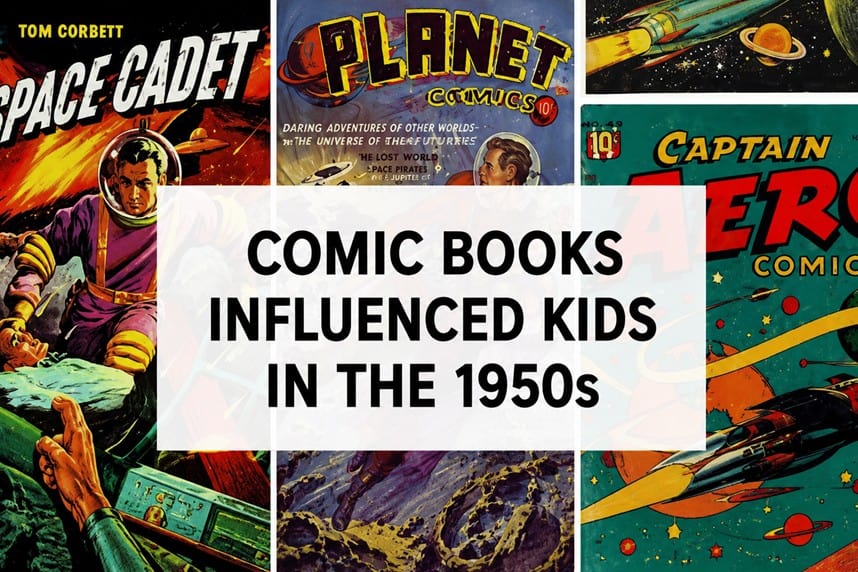
The Rise of 1950s Comic Books
After the war, the hobby really took off. Publishers in the late ’40s and early ’50s put two and two together: there was a ravenous audience for good illustrated stories.
Sure, the superheroes were still in vogue, but the decade was an explosion of all kinds of fare.
Popular Types of Comics in the 1950s
A kid could put his hands on:
- Westerns
- Horror
- Romance
- War and detective tales
- Some funny animal strips
- Or a foray into science fiction
The companies were in a head-to-head for your attention, so you’d see a hundred different titles on the stand each month. What made them so easy to like was that you didn’t need a TV set or any fancy gear. A comic went right in your back pocket or desk.
Why They Were So Big With Kids
There was no mistaking why 1950s comics meant so much to the younger set.
Easy and Affordable Entertainment
It was simple. They were cheap, and you didn’t have to be a voracious reader to get into them. The art and the speech bubbles did the work for you, even if a long novel was a chore.
Escaping Into Another World
Then there was the escape. One minute you’re at home, the next you’re in the middle of a world with some superhuman or a monster or an alien.

Trading Comics With Friends
And it was a social thing. You and your buddies would trade in after school, haggling over who got the best issue or just talking up the new ones.
The Popularity of Superheroes
Superheroes were the big draw. Superman, Batman, Wonder Woman, Captain Marvel — they were icons.
To a teenager, they were the very image of what it meant to be strong and do the right thing. You’d read a story, and for a while you were out there with them, putting up with the bad guys.
It even bled over to the playground; you couldn’t go through recess without some kid trying to fly like the Man of Steel or put on a Batman routine.
Television was on the rise, but a comic book let you make the story your own in a way a screen never could.
Horror and Science Fiction Comics
Of course, not every page was a superhero. By the 1950s, horror and sci-fi had become a hit in their own right.
You could open up a comic in the 1950s and be met with tales of aliens, haunted houses, robots, and all manner of odd creatures. It was no accident; these were the stories of an era fixated on science, the final frontier, and the unease of the Cold War.
Teens in particular had a taste for the more suspenseful fare. A well-drawn panel of some strange beast would draw in a crowd.
But not everyone was on board. Some parents and educators felt it was all a bit much for the younger set, sowing the seeds for what would become a row over censorship.
The Comic Book Controversy of the 1950s
With popularity came the heat. A number of adults put forward the view that comics were a bad influence, fostering violence or lazy reading.
Then in 1954, psychologist Fredric Wertham made his case in a book called Seduction of the Innocent and became perhaps the most vocal of the critics.
It wasn’t long before you had schools, churches and homes asking if certain books were fit for a child. The horror and crime genres took the brunt of it, with their lurid covers and heavy subject matter.
In the end, the industry put together the Comics Code Authority to put some guardrails on things and make them more palatable for the family. Some publishers had to rein in their content; others just let their series go.
How Comic Books Influenced Fashion and Trends
But 1950s comics were about more than what was on the page.
Comic Characters on Everyday Items
You’d see the same characters on a kid’s lunch pail, on a toy, or even on a piece of clothing. Youngsters would pick up on a hero’s way of talking or his hair and make it their own. For a lot of kids, that kind of merchandise was just part of the day-to-day.
Comics as Part of Teen Identity
And in the teen world, a good comic was as good as any decoration for a bedroom or a locker. There were plenty who picked up a pencil and tried to put down what they saw in their favorite issues.
In a way, you were defining yourself by the comics you read.
Comic Books and American Imagination
What made 1950s comics stick with you was how they got your mind working.
After you put one down, you might make up a tale of your own, or put on for your friends with some of the lads. They stoked the imagination of a generation in the middle of some big changes.
Long before we were going to the moon, you could find those kinds of ideas in a comic. For a few, it was the start of a career in art, film, or writing.
The Lasting Legacy of 1950s Comic Books
Look around now, and you can still see where it all began. The superhero flicks, the graphic novels, the TV shows – they all have a line back to the 1950s.
And if you’re a collector, a first edition from back then will set you back some cash.
But the real story is in the millions of young people for whom a comic was a rite of passage. It was where you found some thrills and a place to be.
If you were coming of age in the 1950s, a comic book was never just paper and ink. It was there for you in your life, in your friendships, and in the making of who you were.