
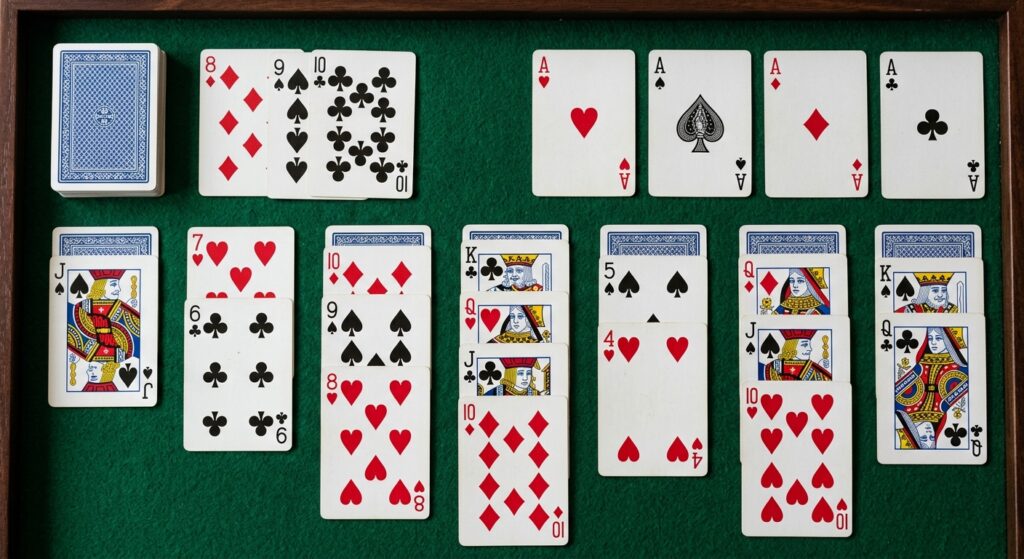
Some forms of leisure need a crowd. A game of solitaire needs a deck, a flat space, and one person’s willingness to see what the cards allow. That made it a natural companion to the quieter side of family life long before a screen could deal a hand. You can still see the same seven-column Klondike layout on PlaySolitaire today: a small, familiar puzzle that begins with a shuffled deal and asks the player to work with what turns up. The browser changes the surface, but not the central pleasure of making order from an uncertain arrangement.
A Place for One Player at a Busy Table
The picture of a mid-century household is often crowded with shared entertainment. People remember radio, television, board games, and card nights. Yet the same table had another use when nobody else wanted to play. A person could take out a pack of cards, deal a solitaire game, and put everything away when the kettle boiled or a visitor arrived. It required neither an opponent nor a schedule.
That independence is part of its enduring appeal. A solo game can fill a gap without asking anyone else to join. It may be a quiet afternoon, a stretch before supper, or the last few minutes after a family game night. The player can stop after one deal or begin again. There is no score to report to a group and no argument over whose turn comes next.
Not every family used the same rules, of course. Card games have local names and household variations. For a nostalgia article, that variation matters more than an imaginary universal ritual. Ask three relatives how they learned to lay out a patience game, and you may hear three slightly different answers. The shared thread is not a perfect rule book. It is the sight of cards arranged into a problem that one person can work through at their own pace.
What the Cards Made Visible
In Klondike, the familiar version many people now call simply Solitaire, cards are arranged in seven columns. Some information is face up, while other cards remain hidden. Building the tableau requires alternating colours and descending ranks, and the foundations collect cards by suit. Those rules create a distinctive rhythm. A player can see several legal moves but must also consider which one opens a hidden card or leaves a useful space.
That is why the game keeps its interest even without a rival. The opponent is not another person. It is the incomplete picture. One move may reveal a card that makes the next choice easier; another may leave the layout apparently stuck. There is no need to claim that every deal is winnable, or that experienced players always know the right move. Much of the charm comes from trying a plausible route and discovering what the pack held back.
A physical deck adds its own small details. You square a stack with your fingertips, lift a corner to check a value, and gather the cards at the end. Those actions are not necessary to understand the puzzle, but they are part of why an old card table can be such a strong memory. The game lived not just in its rules, but in the ordinary objects around it.
From a Pack of Cards to a Computer Screen
The transition to the computer did not invent Solitaire. It made a long-standing card pastime visible to a different audience. Microsoft included Solitaire with Windows 3.0 in 1990, well after the 1950s, 1960s, and 1970s that fill so much of this site’s memory. That date is worth keeping straight. A parent who played at a kitchen table and a child who learned the same layout with a mouse were encountering different versions of an older idea.
The digital board preserved the recognisable columns, colours, and foundations while taking over the shuffle and the cleanup. It also made repetition effortless. There was no deck to find, no cards to collect from the floor, and no need for a clear table. A familiar game became one click away, but the central decision remained: which move makes the most of the cards in front of you?
That continuity helps explain why the game survived the change of medium. A modern version is not a museum display of the past. It is an invitation to perform the same small act of looking, choosing, and revising. Someone who remembers dealing physical cards can recognise the arrangement immediately. Someone who first met it on a computer can learn where the layout came from.
What Nostalgia Gets Right and Wrong
Nostalgia is most convincing when it remembers both the object and the experience. It is easy to call every old-fashioned pastime simpler, as if the past contained no frustration or interruption. Anyone who has run out of moves in a patience game knows better. Solitaire was enjoyable partly because it could be difficult, not because every hand ended in a neat victory.
The more useful memory is that leisure could have a boundary. A deal began, unfolded, and ended. Even an unfinished game could be packed back into the box. That rhythm feels distinctive in a world where so much entertainment is designed to continue automatically. It is possible to value the old rhythm without pretending that every screen is the enemy. The same bounded game can be played on paper cards or on a browser page.
For a family revisiting old pastimes, the card game is also easy to show rather than merely describe. Lay out seven columns with a deck and invite a younger player to identify a move. Then look at a digital version together and compare what stayed the same. The conversation does not need to settle which format is better. It can notice how a familiar set of rules crossed from one generation’s table to another generation’s screen.
The Next Deal
A photograph of a card table cannot tell us exactly what each person felt while playing. It can, however, remind us that entertainment was not always a performance for a roomful of people. Sometimes a single player wanted a manageable puzzle and a few minutes that belonged to them. Solitaire still offers that. The cards may be printed or pixels, but the first question remains wonderfully ordinary: what can I do with this deal?