
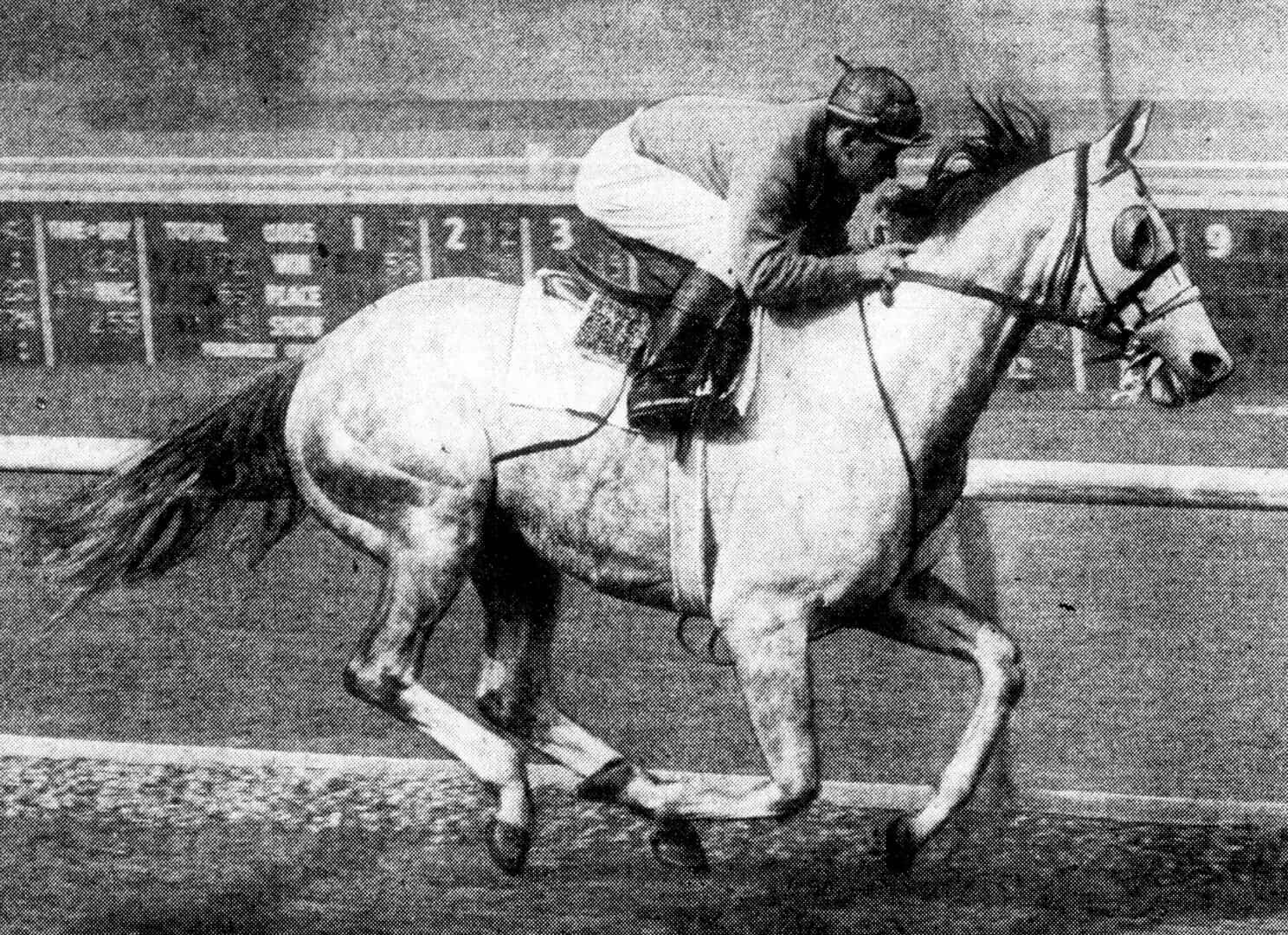
By Unknown author – Los Angeles Mirror, Public Domain, https://commons.wikimedia.org/w/index.php?curid=162166418
The Golden Age of the Belmont Stakes: Revisiting the Most Iconic Races of the 1950s
There are few greater tests of a thoroughbred than the Belmont Stakes. Annually, the race concludes the Triple Crown series in the United States, with the event labelled as the ‘Test of the Champion’.
Some horses have passed this test with flying colors, including Triple Crown champions such as Sir Barton, Secretariat, and American Pharoah.
This year’s event is already shaping up to be one of the most competitive in recent memory, and more information about the contenders can be found here: twinspires.com/belmont-stakes/contenders/
But, who were some of the iconic winners from the Golden Age of the Belmont Stakes during the 1950s?
Native Dancer (1953)
Sometimes a horse comes along that needs little introduction, and that was very much the case in the 1953 edition of the Belmont Stakes. Native Dancer is still regarded as the best thoroughbreds in history, but his running in the 1953 Belmont Stakes could be regarded as one of the biggest what if moments in the sport.
The Gray Ghost was controversially beaten in the Kentucky Derby, leading to questions surrounding his ability at Belmont Park. However, he effortlessly put to bed any doubt surrounding his ability, passing the ‘Test of the Champion’ with flying colors.
He showed desire to win the race despite a grueling battle with Jamie K to win by a neck. His winning time was also striking, with the 2:28 3/5 being the third-fastest finishing time in history. His success is also iconic in Maryland, as he is one of just two duel-Classic winners to come from the state.
Nashua (1955)
Horse racing is a sport that relies on rivalries between competitive horses in order to get the standards of the sport to improve. In 1955, that is exactly what fans of the sport got. Swaps would win the 1955 Kentucky Derby, beating Nashua, but the superstar thoroughbred would set up a sensational rematch between the icons after winning the Preakness Stakes.
Unfortunately, the dream matchup didn’t materialize at Belmont Park, as Swaps opted against running in the Belmont Stakes. Nashua dominated the field, beating Blazing Count by just under ten lengths.
The anticipated rematch between the rivals would eventually come at the end of August, with Nashua getting the better of Swaps. His historic feats on track would see Nashua named the American Horse of the Year. However, the legendary colt is largely remembered as the best horse not to have won the Kentucky Derby.
Needles (1956)
The Triple Crown series in 1956 would be a famous period for the state of Florida, with the Sunshine State breeding the winner of the Kentucky Derby for the first time. Needles would continue to show his excellent ability after his win at Churchill Downs, finishing second in the Preakness, before winning the Belmont Stakes from Career Boy and Fabius.
His wins on track saw him named U.S. Champion Three-Year-Old in 1956, and he was inducted into the Florida Sports Hall of Fame in 1974. Needles was later inducted into the United States National Museum of Racing and Hall of Fame in 2000.
Gallant Man (1957)
One of the most iconic pictures in horse racing history came in 1957, as Bill Shoemaker made amends after famously misjudging where the finishing line was in Gallant Man’s defeat in the Kentucky Derby.
The jockey would stand up in the saddle before the finishing line, allowing Iron Liege to build momentum and win at Churchill Downs. However, he would avenge this mistake at the Belmont Stakes, delivering a historic performance to win in a stake-record time.
Gallant Man’s star would only continue to rise as the season progressed, winning the Metropolitan Mile and the Jockey Club Gold Cup. His legacy lived on after his retirement in 1958, producing Kentucky Derby winner Genuine Risk and superstar filly Gallant Bloom.
Sword Dancer (1959)
Shock results typically capture the imagination of the mainstream audience in horse racing, and few were as hard to believe as Sword Dancer’s victory in the 1959 Belmont Stakes. The colt was overlooked in the betting after finishing second in both of the Kentucky Derby and Preakness Stakes.
However, at Belmont Park, he delivered a devastating turn of foot with Bill Shoemaker in the saddle to win by just under a length. The sloppy conditions at the track favored the strong stayer, and his Belmont Stakes win saw him make history. His victory saw Sword Dancer become only the second horse to finish second in two Triple Crown races and win in one.
The feat has since been achieved on four further occasions, including in 2025 when Journalism finished second in the Derby and Belmont Stakes, but won the Preakness. Sword Dancer’s excellent record on track would continue after the Belmont Stakes, winning the Woodward Stakes on two occasions, and the Jockey Club Gold Cup in 1959.