
Every generation is convinced that the teenagers of its day are speaking a completely foreign language. Whether it’s today’s kids dropping words like rizz, delulu, or sigma, adults usually react with a mix of amusement and bewilderment, wondering where on earth these terms came from.
The comforting truth, however, is that while the vocabulary changes from one decade to the next, the underlying game remains identical. Young people have always invented creative ways to talk in code, carve out their own cultural spaces, and signal a bit of independence from the older crowd. In a nutshell, slang is basically how kids find their people and prove they belong!
To see how this pattern repeats itself, let’s take a trip through how youth culture expressed itself from the 1950s through the 1980s—and how those eras line up with what we hear today.
The 1950s: Greasers, Squares, and Postwar Optimism
Before World War II, young people went almost straight from childhood into full-blown adulthood without much room in between. That all changed after the war, when a booming economy and high school life created a brand-new social stage: the teenager. Suddenly, kids had free time, extra cash, and their own hangouts like drive-ins and soda shops. Businesses quickly took notice, pumping out rock ‘n’ roll music, movies, and clothes catered specifically to them. This sudden “rise of teen culture” turned adolescents into their own distinct group, complete with a shared identity and the slang to match.
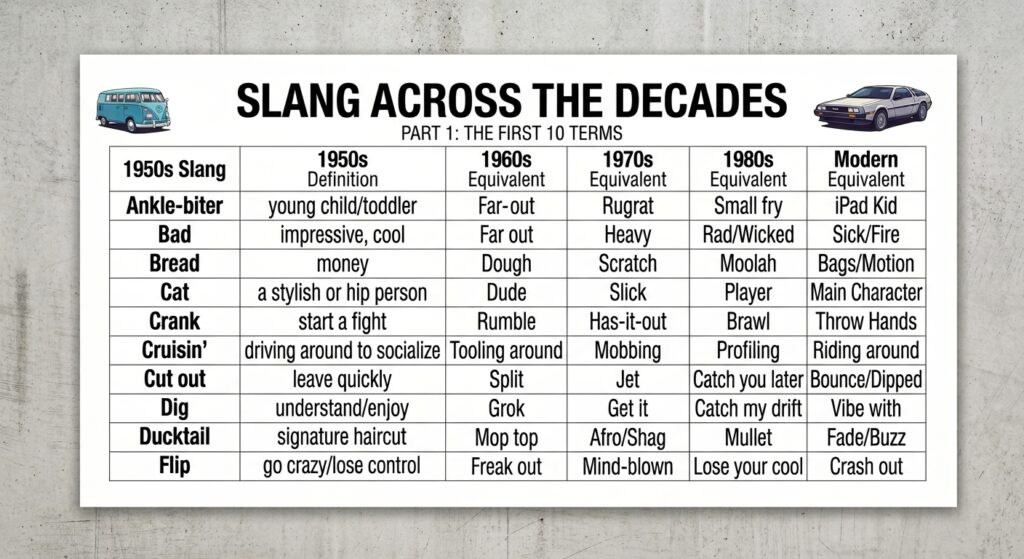
If someone was well-dressed and looking sharp, they were wearing sharp threads or looked sharp as a tack. If an individual was boring, conventional, or a bit out-of-touch, they were labeled a square—the mid-century equivalent of calling someone an NPC or an “unc” today. When things were going well, everything was described as hunky-dory, copacetic, or simply swell. According to places like Merriam-Webster, post-war America saw an explosion of new slang, all thanks to the sudden rise of teen culture.
The 1960s: The Counterculture and “Groovy” Vibes
The social upheavals of the 1960s completely shifted how young people communicated. As the counterculture movement, civil rights activism, and psychedelic rock took center stage, language became far more expressive, colorful, and anti-establishment.
Boring conformity was out; wanting to be hip to what was happening was in. If an event or a song was incredible, it wasn’t just neat—it was outta sight or a major happening. Agreement wasn’t expressed with a simple “okay,” but with phrases like right on or dig it. When someone was acting unrealistic or spaced out, people noted that they were living in cloud-cuckoo-land—the direct historical cousin of today’s delulu. Linguists studying modern slang point out that whenever a cool counterculture movement pops up, standard everyday words start changing meanings quicky.
The 1970s: Disco Culture and Street-Smart Swagger
By the 1970s, disco, funk, and urban street culture heavily influenced mainstream youth slang. It was an era defined by big personalities, bold fashion, and a mixture of casual confidence.
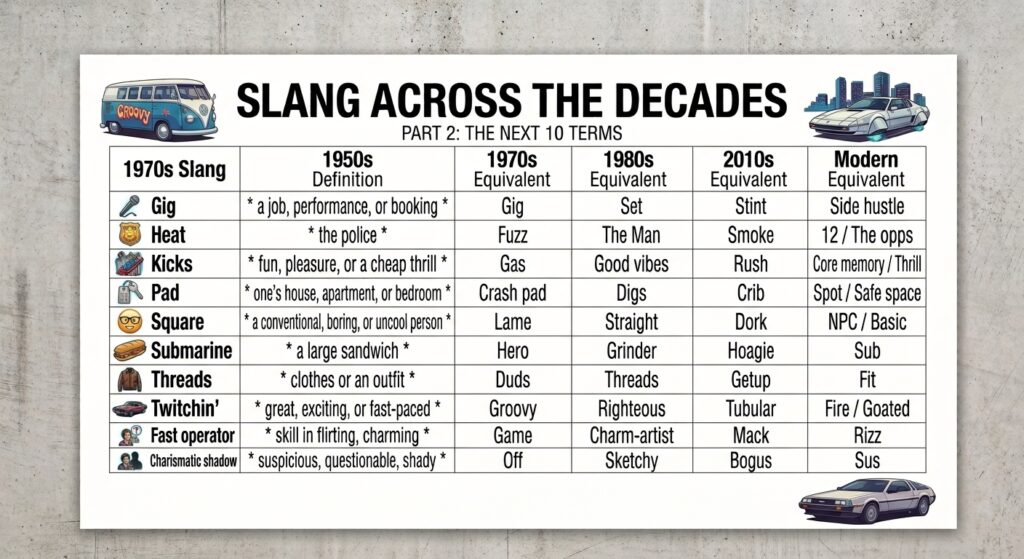
Top-tier quality or exciting new things were often called primo or gravy. If someone was complaining excessively or making a big deal of things, peers might point out that they were on a heavy trip. Meanwhile, plans that were locked in and secure were kept on the QT. The lingo was all about looking smooth and showing off your personal style—something cultural mags like Smithsonian love looking back on.
The 1980s: Mall Culture, Valley Slang, and MTV
The 1980s brought a massive commercial explosion of teen culture driven by John Hughes cinema, shopping malls, and the rise of MTV! This decade gave us some of the most recognizable and widespread colloquialisms in modern history.
Excellence was captured in words like rad, totally tubular, or wicked. If someone was behaving foolishly, they were often called bogus. Instead of modern phrases like “no cap,” 80s teens assured each other they were telling the truth by saying for real or no bull. It was energetic, highly performative, and wrapped in neon attitude.
The Big Picture
When modern teenagers use words like rizz (historically equivalent to having a smooth “line”) or call something sus (the modern evolution of calling a situation “fishy”), they aren’t inventing a brand-new wheel. They are simply applying a fresh coat of paint to a very old vehicle.
Language is dynamic! Every new generation adapts, reinvents, and plays with vocabulary as a way to make sense of their world before passing the baton to the next group. Slang isn’t a sign that language is breaking down—it’s just proof that it’s alive and well!