
Welcome to 1950s Cars – Studebaker


1950 Studebaker Champion
Studebaker was one of the few American automakers to introduce a genuinely new design for 1950. The company rolled out two series that year: the Champion, offered in three trim levels, and the more expensive Commander, which rode on a longer wheelbase.
The Champion quickly stood out from the crowd, especially in the Starlight Coupe shown here. Its most eye-catching feature was the dramatic wraparound rear window, giving the car a futuristic look that was unlike anything else on the road at the time.
Cost: $1,419.00
1950 Studebaker Champion Regal DeLuxe
Studebaker wasn’t interested in making another ordinary-looking postwar car.
To set its models apart from the competition, the company’s designers introduced the distinctive “bullet nose” grille, one of the most recognizable features of Studebaker’s 1950 lineup.
The rounded nose gave the Champion Regal DeLuxe a futuristic appearance and helped establish Studebaker’s reputation for thinking a little differently about automotive design.
Cost: $2,287.00
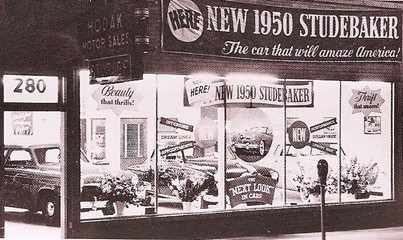
Studebaker showroom unveils new models

1951 Studebaker Champion
The Studebaker Champion was the economy model in the lineup, but that didn’t mean it was short on style or efficiency. For 1951, the higher-end Commander and Land Cruiser models received V-8 engines and adopted the Champion’s shorter 115-inch wheelbase.
The Champion also earned a reputation for excellent fuel economy. Studebaker models performed impressively in the Mobilgas Economy Run, a popular competition that put cars to the test for fuel efficiency. In an era when gas mileage was becoming an increasingly important selling point, that was a pretty useful feather in Studebaker’s cap.
Cost: $1,680.00
1952 Studebaker Commander
After the slowdown caused by wartime production, Studebaker continued to hold its place among America’s leading automakers.
For 1952, the Commander received a major facelift, including the addition of a much-anticipated hardtop coupe. The popular wraparound rear window remained one of Studebaker’s signature design features.
Cost: $2,220.00 
1952 Studebaker Commander State Starliner
The public loved it, but critics weren’t nearly as impressed. Studebaker also moved away from its distinctive “bullet nose,” replacing it with a more restrained wraparound split grille. It was a bold change for a company known for taking chances with automotive styling.
Cost: $2,488.00
1953 Studebaker Commander Starlight
Studebaker gave its entire lineup a top-to-bottom redesign for 1953, and the Starlight and Starliner Coupes stole the show. Dramatically low and long, they looked unlike anything else on the road. Buyers loved them so much that demand outpaced production, leaving Studebaker unable to build enough cars to meet the demand.
Cost: $2,233.00
 1953 Starlight’s European style interior


1954 Studebaker Commander Starlight
The Starlight Coupe may have been Studebaker’s signature model, but the four-door Land Cruiser was actually the top seller. Studebaker’s advertising continued to highlight its connection to legendary industrial designer Raymond Loewy, whose design team had created the dramatic new look that debuted the previous year.
Cost: $2,411.00
 1954 Studebaker Commander Interior

Studebaker was among the first automakers to use nylon blended with vinyl for car upholstery, giving its interiors a fresh, modern feel. Two-tone upholstery, like the example shown, was also available as a no-cost option, adding a little extra style without adding to the price.

1955 Studebaker President Speedster
The President Speedster arrived midway through 1955 after first appearing as a popular concept car at auto shows.
Studebaker put it into limited production, giving buyers a flashy new option with standard two-tone paint in attention-grabbing combinations like pink and black or lemon and lime. Inside, matching hand-stitched quilted leather upholstery completed the look.
Cost: $3,250.00
1956 Studebaker Golden Hawk
The Golden Hawk evolved from Studebaker’s 1953–55 Sport Coupe, but this new model had the power its predecessor was missing.
Under the hood was a 275-horsepower V-8 borrowed from Packard, giving the sleek coupe plenty of muscle to match its sporty looks. Other Hawk models in the lineup included the Sky Hawk, Power Hawk, and Flight Hawk.
Cost: $3,061.00

1957 Studebaker President

Studebaker offered its sedans in three trim levels for 1957, with the President at the top, followed by the Commander and Champion.
While the sporty Hawk models embraced the era’s growing fascination with tail fins, the Studebaker sedans took a more restrained approach and went without fins that year.
Cost: $2,560.00
 1958 Studebaker Golden Hawk

The Golden Hawk received a few updates for 1958, including air conditioning and 14-inch wheels, but otherwise remained largely unchanged. Production fell to an all-time low of just 900 cars.
Meanwhile, the budget-priced Scotsman enjoyed a stronger sales year, while the Packard name disappeared midway through the season, marking the end of an important chapter in Studebaker’s history.
Cost: $2,728.00

1959 Studebaker Lark
The Studebaker Lark arrived at just the right moment. As the nation slipped into a recession, buyers were looking for smaller, more economical cars, and the Lark fit the bill.
It gave Studebaker a much-needed boost, helping production jump by about 150% while sales nearly doubled. Buyers could choose from two- or four-door sedans, a two-door hardtop, and a station wagon.
Cost: $2,275.00
I purchased this model used Studebaker around 1965 in the state of North Carolina. It was used of course. Black exterior. Had radio speaker in rear. I bought red plaid seat covers from Sears. Loved the car! Had to sell due to job change and move overseas with American Red Cross.