
Every November 22, the anniversary of John F. Kennedy’s assassination gets everyone talking about the old rumors again. And whenever the Kennedys are in the news, you can bet Marilyn Monroe’s name is right there with them. Many have spent decades swapping stories about late-night phone calls, secret affairs with Jack and Bobby, and whether she knew a little too much for her own good. It’s one of those classic Hollywood-meets-Washington mysteries that never really goes away. Read below for details about Marilyn Monroe’s death and click here for more about the life and scandals of Norma Jean.

Inside Marilyn Monroe’s Death Certificate
But before you get lost in all the conspiracy theories, it’s worth looking at what actually went down on paper. We love digging into the real documents here, and nothing cuts through the gossip quite like the cold, hard ink of an official record. So, in honor of the anniversary—and the woman who’s always tied to it—let’s take a closer look at Marilyn Monroe’s death certificate from 1962.
From the Coroner’s report dated August 5, 1962.
“The unembalmed body is that of a 36-year-old well-developed, well-nourished Caucasian female weighing 117 pound and measuring 65.5 inches in length. The scalp is covered with bleached blonde hair. The eyes are blue. The fixed lividity is noted in the face, neck, chest, upper portions of arms and the right side of the abdomen. The faint lividity which disappears upon pressure is noted in the back posterior aspect of the arms and legs. a slight ecchymotic area is noted in the left hip and left side of the lower back. The breast shows no significant lesion. There is a horizontal 3-inch long surgical scar in the right upper quadrant of the abdomen. A suprapubic surgical scar measuring 5 inches in length is noted…
…The stomach is almost completely empty…
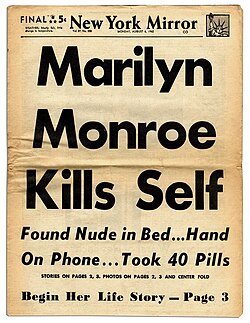
…Now that the final toxicological report and that if the psychiatric consultants have been received and considered, it is my conclusion that the death of Marilyn Monroe was caused by a self-administered overdose of sedative drugs and that the mode of death is probable suicide.
The final toxicological report reveals that the barbiturates, previously reported as a lethal dose, has been positively identified as Nembutal by the toxicologist.
In the course of completing a routine examination, the toxicologist, Mr. Raymond Abernethy, discovered in addition to the Nembutal present a large dose of chloral hydrate.”
From the Psychiatric Investigative Team headed by Dr, Robert Litman, M.D, Norman Parberow, PhD and Norman Tanachnick M.D.:
“…Miss Monroe had suffered from psychiatric disturbance for a long time. She experienced severe fears and frequent depressions. Mood changes were abrupt and unpredictable, Among symptoms of disorganization, sleep disturbance was prominent, for which she had been taking sedative drugs for many years. She was thus familiar with and experienced in the use of sedative drugs and well aware of their dangers.
Recently, one of the main objectives of her psychiatric treatment had been the reduction of her intake of drugs. This has been partially successful during the past two months. She was reported to be following doctor’s orders in her use of the drugs; and the amount of the drugs found in her home at the time of her death was not unusual.
…We have learned that Miss Monroe had often expressed wishes to give up, to withdraw, and even to die. On more than one occasion in the past, when disappointed and depressed, she had made a suicide attempt using sedative drugs. On these occasions, she had called for help and had been rescued…”

Checkout Marilyn Monroe collectables here.
Medications Found at the Scene
-
Two different prescriptions for Librium (5 mg and 10 mg capsules).
-
Sulfathallidine tablets.
-
An empty container for Nembutal (1½ gr., originally 25 capsules) filled on August 3, 1962.
-
Chloral Hydrate (0.5 gm green capsules, with 10 remaining from a 50-capsule prescription).
-
An empty container for Noludar from November 1961.
-
An unlabeled container holding 32 pink Phenergan (25 mg) capsules.
Haven’t had enough? Read more about the beautiful icon here.
When you read the official file line by line, it’s easy to see why this case has fueled six decades of debate. On paper, Dr. Thomas Noguchi and the coroner’s psychiatric team laid out a clear, clinical picture: a woman with a well-documented history of severe depression and sedative dependency, lethal levels of Nembutal and chloral hydrate in her system, and an empty prescription bottle filled just the day before. Yet for conspiracy theorists, those same pages leave just enough wiggle room—like that nearly empty stomach and the hedge of “probable” suicide—to keep the Kennedy rumors alive every single November.
Ultimately, the official documents about Marilyn Monroe’s death give us the medical how, even if Hollywood and Washington history will forever argue over the why. What do you think after reading the coroner’s actual words—does the official record settle the case for you, or do you still suspect there’s more to the story?